CLICK HERE FOR BLOGGER TEMPLATES AND MYSPACE LAYOUTS »

Blog and Store Links

Showing posts with label Gardening. Show all posts

Urban Foraging: Dandelion Coffee

Start by foraging for dandelions. For best results search in fall or early spring. After the Dandelions have experienced a frost, their flavor will enhance. When you have found some, bring them into the kitchen and wash thoroughly. Cut off all the green: You only need the carrot like roots. 


Grind the roots in a food processor until they resemble orzo or bloated over-cooked rice. 

Spread the ground roots out on a cookie sheet that you don't mind staining.

Place grounds in a oven at 220 degrees Fahrenheit. You will need to watch carefully so they don't burn. When they are done you will notice that the roots are the color of coffee grounds. You will also notice faint smoke tendrils coming from the roasted roots.
You can further grind the grounds or leave them chunky. To brew: In a pot bring 1 cup of water to 1 tablespoon of Dandelion Coffee to a boil. Boil for 5 minutes and use a small strainer to sift out the grounds. 


Dandelion Coffee is a non-GMO, sustainable, environmentally sound product. It has no caffeine and is loaded with health benefits. And best of all you can gather these weeds for FREE.

15 Great Crops To Grow In The Pacific Northwest

Fall Vegetable Garden Ideas
15 great crops to grow in the Pacific Northwest for a beautiful and nutritious Fall garden.

  • Arugula start seed in late summer, to harvest up until frost.
  • Beets_ Begin planting beet seeds directly in the garden one month before your last spring frost date, followed by a second planting two to three weeks later. Beets prefer a well-drained, sandy soil. Avoid high nitrogen fertilizers as this will encourage top growth at the expense of root development. As with all root crops good soil aeration is key to uniform, robust development. Consistent moisture is also important. Keep areas weed free to avoid competition for nutrients.
  • Broccoli(Transplants)  Broccoli seedlings should be planted 10 weeks before the first frost date in your area. This means planting them during the last hot summer days so it's important to mulch around them to help keep the ground cool and moist. Feed the plants 3 weeks after transplanting into the garden. Use a low nitrogen fertilizer. 70 days to maturity.
  • Brussels Sprouts (Transplants) Brussels sprouts are ideal for fall gardens because they really taste best when allowed to mature in cool weather. In my mid-South garden, summer comes too quickly to grow them in the spring garden. Set the plants out in mid-summer. It will take about 3 months before the sprouts appear. They are ready for harvest when they are firm and green. 90 days to maturity.
  • Cabbage (Transplants) Plant seedlings 6 to 8 weeks before the first frost. If the heat of summer is still intense when it's time to plant in your area, give the young plants protection from sun. Cabbages are heavy feeders that require fertile soil rich in organic matter and consistent moisture. 70 days to maturity.
  • Carrots Begin sowing seeds for fall and winter carrots 10 to 12 weeks before your average first fall frost.
  • Cauliflower (Transplants) Plant seedlings 6 to 8 weeks before the first frost. Cauliflower can be tricky to grow. Rich soil and consistent watering are the keys. Fluctuations in temperature, moisture and nutrients can cause the plant to "button" or produce small, undersized heads. Blanch the heads by tying the outer leaves together over the heads when they are about 2 to 3 inches across. This keeps them from turning green and becoming bitter. 60 days to maturity.
  • Collard greens _ Plant 6 to 8 weeks before the first frost for fall and winter harvests.
  • Kale (Transplants) _ You can begin planting kale 6 to 8 weeks before the first frost for fall and winter harvests, and continue planting throughout the fall in zones 8, 9, and 10.
  • Kohlrabi _ Is a member of cabbage family, but it looks and tastes similar to a turnip. The bulbous edible portion grows just above the soil line. Shade young plants from summer sun. 40 to 60 days to maturity depending on variety.
  • Mustard greens Sow seeds 6 weeks before the first frost. Seeds will germinate in soil that is 45 to 85 degrees F. Keep the soil consistently moist to encourage rapid growth and tender greens. 45 days to maturity.
  • Radishes Sow seeds for radishes 4 weeks before the first frost. Winter varieties such as China Rose, mature slower, grow larger and store longer. They should be sown about 6 weeks before the first frost. Sow the seeds evenly so you don't have to thin them. No feeding necessary, but soil should be fertile and well drained. They are quick to mature so check them regularly. They are ready to harvest as soon as they are of edible size. 25 to 50 days to maturity depending on variety.
  • Spinach Sow seeds 5 weeks before first frost date. The short days and cool, moist weather of fall is even better for spinach than spring. An established spinach crop will last well into winter and can survive temperatures down into the 20s. Spinach prefers very fertile soil to encourage rapid growth and tender leaves. 45 days to maturity.
  • Swiss Chard If daytime temperatures are still over 80°F, start seeds indoors 11 weeks before the frost date, or purchase transplants (if available). The plants will mature more slowly in the fall because the days are shorter. If you provide some protection, you can continue harvesting after the first fall frost.
  • Turnips Any well-drained soil will do. Consistent moisture is key for healthy root development. Although it is not necessary, the greens will be the most tender if you plant in a fertile soil.

FROST DATES FOR OREGON 
FROST DATES FOR WASHINGTON
FROST DATES FOR MONTANA
FROST DATES FOR IDAHO
FROST DATES FOR CALIFORNIA
FROST DATES FOR COLORADO
FROST DATES FOR NEVADA

Homemade Jammy Jam

Well...it is canning season at our house, and boy have we been  busy. We have been super blessed this year, we have had a very productive plum tree, as well as a booming blackberry bramble. We have also had an abundance of beautiful tomatoes. I really wish it wasn't so horribly hot as it is, but it is August and at least we got a Summer season this year. Some years it seems like Spring just merges into Autumn, oh well. We also had a blazing hot July this year with 13 days at or over 100 degrees. Our tomatoes turned red, berries turned purple and the plums did too. So, we ran to our local bimart and bought us a pressure canner and some jars. Wish us luck on our new-ish project canning. New-ish because we can, however we have never owned a pressure canner, or had the opportunity to put up as much produce as we have this year.


Blackberry-Plum Jammy Jam:
  1. Place 8 cups of pitted, skinned, and halved plums into a mixing bowl & drizzle with 8½ cups of sugar and 4 cups of blackberries. Stir plumbs and berries until they are coated with sugar. Let them sit for 1 hour or 2 than transfer the mixture in to a big pot.
  2. Bring the mixture to a boil uncovered, while stirring occasionally. Boil until mixture is bubbling hot and simmer for 10 minutes than turn off the heat. Cool to jam reaches room temperature. Mix in a box and a half of pectin.
  3.  Bringing mixture back to a boil and then the lower temperature, stir frequently to prevent scorching. Do this for 5 more minutes or until the jam slowly rolls off of a cold spoon (what is known as jelling stage).
  4. Ladle it into hot sterilized jars.  Put on lids and rings which were also hot (YO! don't boil your lids).  Tighten until they are finger tight, but don't over-tighten you WILL crack the jars.  Place in water bath canner and process for 10 minutes.

Make A Bee Condo


I recently stumbled across the Global Bee Project a website that promotes bee guardianship . Well I thought it was cool enough to write about. I have a garden and I don't know what I would do without the little bees pollinating everything for me . I have noticed that I don't have the bees that I did a few years ago "may-bee" it it the lack of marigolds (my sister is allergic) however it has bugged me since my squash numbers have went down ,so I built my self a bee condo above and placed it along my neighbors fence. I am also going to make a bee nest out of either bamboo or dried blackberry stems . Bee condo's don't attract colonies just solitary bee's like masons the bees which are not aggressive and don't sting. These bee's like to dwell in holes that are 3-10 inches deep and 3/32" and 3/8" in diameter . Place you bee condo facing east they like morning sun. Don't spend money buying one when they are so easy to make all you need is some non-chemically treated wood ,a drill ,and some nails .

Kohlrabi and Cabbage


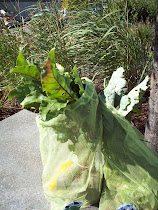
I am so happy to have my garden in full swing again . I love spending time outside planting and digging . I am ecstatic that in a week or so I will have large scrumptious cabbage to eat on. I have already pulled up some kohlrabi which is a alien type of veggie that my mom recalls eating all the time in North Dakota. I started my pea's a little late so I am hopping they will be okay and not burn off in this heat wave we are experiencing in So. Oregon. The corn is doing well and I have been seeing lots more sprout up over the past couple days. Our lettuce is being pulled constantly since I am on a salad binge recently, I can't explain it I just can not stop eating lettuce. This year like most years; my garden is consisting of experimentals like lettuces I have not ever planted or ones that have not been planted for years. This year it's a mix of 14 greens attazione, bionda, arugula , kale , chicory, swiss chard etc. and they are crazy good. I found some organic red potato seeds and those will be ready for harvesting in no time. As well as the tomatoes this year (( crazy-growing)).  I am giving a cherry tomato called the 100 or something like it a try - I hope they are sweet . I can't plant to much -just what fits in my 12x12 planting space I wish I had more room, but I will just have to be more creative.

Composting

Did you know that 2/3 of American waste could be recycled by COMPOSTING yes composting . You and I can benefit from our own trash as well ,compost is full of beneficial nutrients that most soil lacks.It also is a lot cheaper than commercial chemical fertilizers and is eco-friendly . When organic matter is crushed in landfills it releases harmful methane gas that is 23 times more harmful than carbon dioxide.
You can compost:
coffee grounds and filters
dryer lint
eggshells
manure from chickens,cows,rabbits,horses
ashes, bark,paper,vegetables
grass clippings and more

Keep in mind that that you need about 2/3 brown to 1/3 green . Keep your compost turned to allow plenty of oxygen to break down the pile and to prevent it from compacting. Click on the side links for more resources if you are interested.